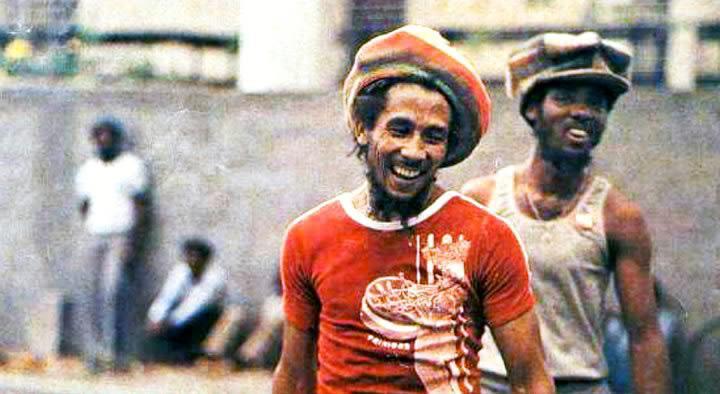
In 1980, English radio DJ and self-described reggae junky David Rodigan interviews Bob Marley upon his return from performing at the Zimbabwe Independence Celebrations in Rhodesia. As journalist Nazma Muller describes, it’s an interview 6 years in the making.
In 1974, he and his girlfriend went to see Bob at his very first show in London. The first song the Wailers did was “Rastaman Chant”, a non-stop flight to Nirvana for the massive crowd. At the end of the show Rodigan knew there was no way he was going to get past the hundreds of fans waiting outside the stage door. He and his girlfriend left. “I came out and walked down Fulham Place Road where I saw this enormous cloud of smoke come out of a shop doorway. When the smoke cleared, there was Bob Marley on the end of a big spliff.” Rodigan stood frozen, his moth dropped open and he squeaked, “That’s Bob Marley!” He was stupefied. He didn’t know what to do or say. His girlfriend stared at him. “What do you mean?” she said. “Go and say hello. I’ve heard you go on for years about this man.”
So Rodigan walked up to Bob and said, “You don’t know me but I know you” – or something equally inane. “I just want to say thank you,” he continued, mouth dry, heart palpitating. “I’ve waited so long for this night. I as in that ram jam session and it was just absolutely brilliant and thank you for everything.” Bob replied, “One love. Rasta!” and shook Rodigan’s hand. Shortly after, a car roared up and Bob got in but as it drove off, he turned round and waved at the dazed David Rodigan. The stunned teen just stood there, waiving back.
Four years later, the path to meeting Bob a second time opened up. The presenter of Reggae Rockers, a BBC radio show, left. Rodigan’s girlfriend pretended to be him and wrote a letter to the producers saying he was the best thing in reggae fandom, and they should invite him to audition for the slot. Fifteen minutes into the audition however, the interviewer stopped Rodigan and said, “I’m terribly sorry to have to stop this interview, but I’m afraid we can’t offer you the job because you’re the wrong colour.”
Rodigan didn’t get upset; he knew where the guy was coming from. “I understood perfectly because there was I, a white person, wanting to present a black music programme.” It was hard enough for black people to get jobs in the media then, Rodigan didn’t want to take on the few they had a right to.
Back in London, he met Bob Marley again. He had gone to Island Records’ office where Marley was rumoured to be hanging out, having just returned from Zimbabwe’s independence celebrations. Rodigan spotted him coming down the stairs, surrounded by his ubiquitous entourage. The two were introduced by and Island official. But instead of shaking Marley’s hand, muttering a platitude and then begging Marley’s manager for an interview, as was the custom, Rodigan said to the superstar, “Will you come on my show on Saturday night?” There was a collective gasp at his audacity. Minders looked uncomfortable and mumbled that he wasn’t doing interviews. Bob Marley looked at Rodigan, looked around at a couple of his people and then back at him and said, “Ahright.”
Sure enough, the following Saturday night, Marley showed up at Capital Radio’s studios. Rodigan took him into a small room before the sow and said, “Bob, I don’t want to talk about politics, religion or anything like that. I just want to talk about the music. Is that okay?” Marley grinned and said, “Yes!” So they talked about music, and the tunes Marley made and why he made them. “I was nervous as a kid,” says Rodigan. “My voice was like (he squeaks in a falsetto), ‘Bob Marley, oh my God!’ I was shaking like a leaf. I could hardly cue up the records. It was 1980 and I was interviewing Bob Marley. It doesn’t get much better than that.”
I have included an excerpt from Rodigan’s interview with Bob Marley:
Vodpod videos no longer available.
 LEGENDARY REGGAE